“We help the dead to inhabit death; they help us to inhabit life. We are as much their angels as they are ours.”
– Greg Mogenson, Greeting the Angels
On 28 August 2024, I began the week’s transition out of the teaching and learning position I started that same day in 2000, then a week after Pops died. At retirement, I found myself walking back into our last morning together, rather like an episode of Unforgettable, with a main character who visually remembers everything in her life, the episodes filmed so she becomes the watcher of herself in a specific plot-advancing moment.
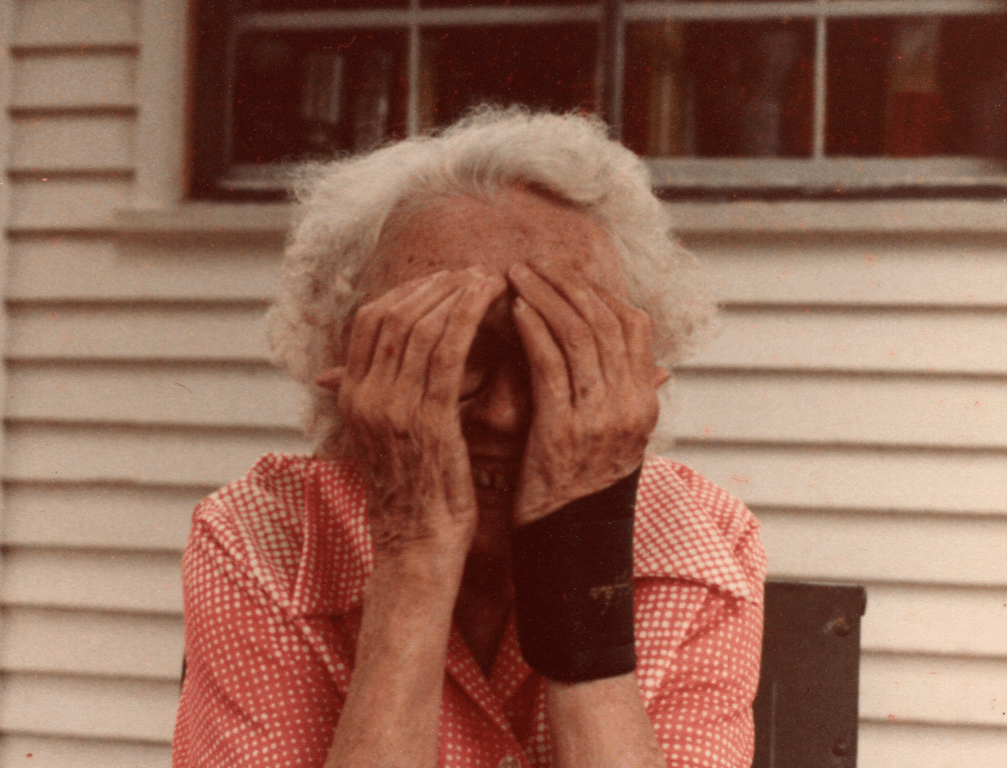
In 2024, I watched Pops and me in the hospice space we made from my playroom: a single hospital bed beside bookshelves he had made for me – books replaced by medicines and comfort supplies. From a lone chair in the space between, the 2000 me accumulated these visual data: He’s drawn the covers to just below his armpits. Both feet are, as always, uncovered. His thumbs are curled under the covers, and his so very long and slim fingers hold the sheet and heavy blanket into place. His hands. My grandmother’s hands. Her grandmother’s hands. Almost my hands. I rewatch myself appraising them with elbows on the bed, fingers pointing to the ceiling to more easily inspect first the palm- and then the knuckle-side of each: The palm width and finger double-jointedness match, yet my own hands come up short in two ways – my thumbs single- not double-jointed, and all ten fingers are stubby rather than elegantly long. These are my own hands, not fully my father’s nor my mother’s smaller-in-all-ways hands.
*** *** ***
After Pops’ July 2000 diagnosis of inoperable metastasized cancer, Gram had been with Pops and me daily, the angel in our midst. Regularly interrupting my dreams, she’d send me to talk with or care for or simply sit, in person or by phone, with my father, the third of her four sons. In person, I’d be drawn to the room by hearing urgency in his voice or respirations, or by my own need for “just one more chance” for talking and listening, or finding favourite music, or maintaining a habit of sitting in quiet company. On those occasions, there was often a single first or only word from my father – “Ma.” He was not mistaking me-the-daughter for the ten-years-dead mother. More realistically in our lives, he too recognised that we were three beings in the room, not simply two people.
On the morning Pops would die, Gram called me to leave my sleeping nest on the living room couch. “Go now. He needs you there so that he can leave.” I sponged his lips and chin brushing away the slabber rejected by his closed up lungs, washed his face, hair, and torso to cool and calm us each, and spoke quietly through the baby monitor to Mom, yet and finally sleeping. During those few minutes of ritual while Mom roused, “Ma,” a reminder of Gram with us in the room.
Mom arrived, trailed by my 25-years-dead grandfather who eased into the frame to stand behind me. We were the five of us as we so often had been on the front porch or in the garden behind the family homeplace. Only this time, freed from the confines of “in real life” interactions, Gram could gather up his matching hand in hers for a spell, then lean to kiss his eyelids, her hand moving to caress the small of Mom’s back. Grumpy held me up, unhesitatingly kissing the back of my head as I bent to Pops’ ear:
“We’re all here, you can go now.”
“Ma…”
For a long minute, I left the room to Mom and that trio.
On my return, I closed his eyes.
Now three guardians caring for the wife and daughter whose lives shifted with that last-breath utterance
*** *** ***
I had returned to that visual memory one other time – 4 April 2018, Pops’ should-have-been 88th birthday, which became the reckoning day for DNA results placing him as “not my biological father,” and throwing a “biodude” into the mix. The testing data were not entirely a surprise, there had been grade school era moments when I wondered if their wedding just 38 days before my birth indicated something more than young twenty-somethings trying to figure out the impact of an unplanned pregnancy on their lives and love.
More stunning ache than surprise.
For a couple of days, I kept my life at home to three rooms accessible from the back porch: kitchen, bathroom, and bedroom. I couldn’t bring myself to go to other rooms, for that required walking past the dining room sideboard with its photos of the five generations who made the Tracy, Minnesota, houses and gardens a homeplace. That small generationally extended family of my growing up celebrated its storied Welsh lineage even more than the English and Irish genealogies that branched into Mayflower and Revolutionary War society memberships. Would I look on those photos and see myself as “not Welsh,” as not Alexander?
Could I come to view as nurture that bond made in knowing that my grandmother raised my brain in much the same way her grandmother had raised hers in matters of learning, where seeking to understand and enact justice in the world balanced on reading widely and being in community with others, where Welshness was a matter of ethics and ethos as much as history, where the practicalities of cooking and gardening as well as caring for home and for community were equal to any other work in the world? What was I to make now of that now social rather than biological matrilineal web of grandmothers who were teachers of their granddaughters?
As a scholar and teacher I had anchored myself in the lessons and poetry within Hannah Evans’ 1874 teaching journals from the banks of Lake Sarah in southwestern Minnesota. As a first generation college student, I drew strength from the porch stories about my Hannah, her granddaughter, being taken from school as a young girl to help with running that homeplace as a boarding house in the 1910s, then using books from the top-of-staircase bookcase to carry on learning.
My Hannah schooled me to be a learner from infancy with photo albums, her aunt’s genealogy notes, and U.S. and Welsh in Minnesota history books spread across whatever table had the best light. Different from Little House on the Prairie stories we read aloud for their setting near the homeplace and her parents’ own South Dakota homestead, in Gram’s family storytelling, indigenous peoples were neighbours and maltreated by governments, and homesteaders weren’t the first to make farms and communities in spaces they were “given” to settle.
*** *** ***
Gram and Grumpy arrived during that 2018 week for another round of angeling work, embracing me with the hands and hopes that raised me. As an imaginal grief memory, their presence nudged me forward: These angels of mine, if I believe the multiple creation or origin stories that shape my agnostic view of birth and death – and I do, came to know my DNA origin story and my soul creation story. Because of that second one, I was and would remain theirs. DNA could not unmake my being “one of them”.
They have not let go, and we are still here:
Let the wind blow from the East,
let the storm roar from the sea.
Let the lightning split the heavens,
and the thunder shout “encore!”
In spite of everyone and everything.
We are still here.
– Yma O Hyd / Still Here – Dafydd Iwan, 1983
 The Truth of Things