Dod yn ôl at Fy Nghoed [Returning to my trees] – a Welsh proverb advocating a “return to balanced state of mind”
blank line
Rhizomatic thinking is an attempt to give a picture for showing how seemingly unconnected things can actually form meaningful connections for us. – Dave Cormier, glossary on rhizomatic learning and curriculum
*** *** ***
The 2018 Ancestry DNA spit test situating me as a biological disconnect from “my Alexanders” might well have been accompanied by a “No Through Road” UK road sign marking the way as closed; with no secondary “Diversion” offered, I wasn’t sure how to find new routes on my own for the ongoing Welsh family search, much less for this new diversion in my dna strands.
Not up to travelling solo on these two journeys, I created a Facebook album as an essay to tell the new origins story, and to ask others to join me on this rerouting. Also, I could not fathom ways of enduring the bodymind costs that would come with telling 54 first cousins and their families individually, nor reaching out in phone calls or batches of emails to decades of friends now living across most of the world’s time zones. Closing that essay, I offered this:
The long story short in terms of affective impact is that I find myself loving Pops more deeply, understanding Mom more keenly, and celebrating each day all that they taught me, without saying a word, about choice and nurture, community and kinship, and making genealogies of love.
Responses landed in two main categories: the “love your dad even more” of long-time friends and maternal cousins, and the “screw-dna-you’re-still-our-cousin-and-family-historian” chorus, of Pops’ kin, led by the cousin who had taken the test alongside me, hoping to discover that somewhere in Wales there were folks wondering what had become of family who had ventured to the United States during an 1840s exodus imposed by industrialisation in Wales.
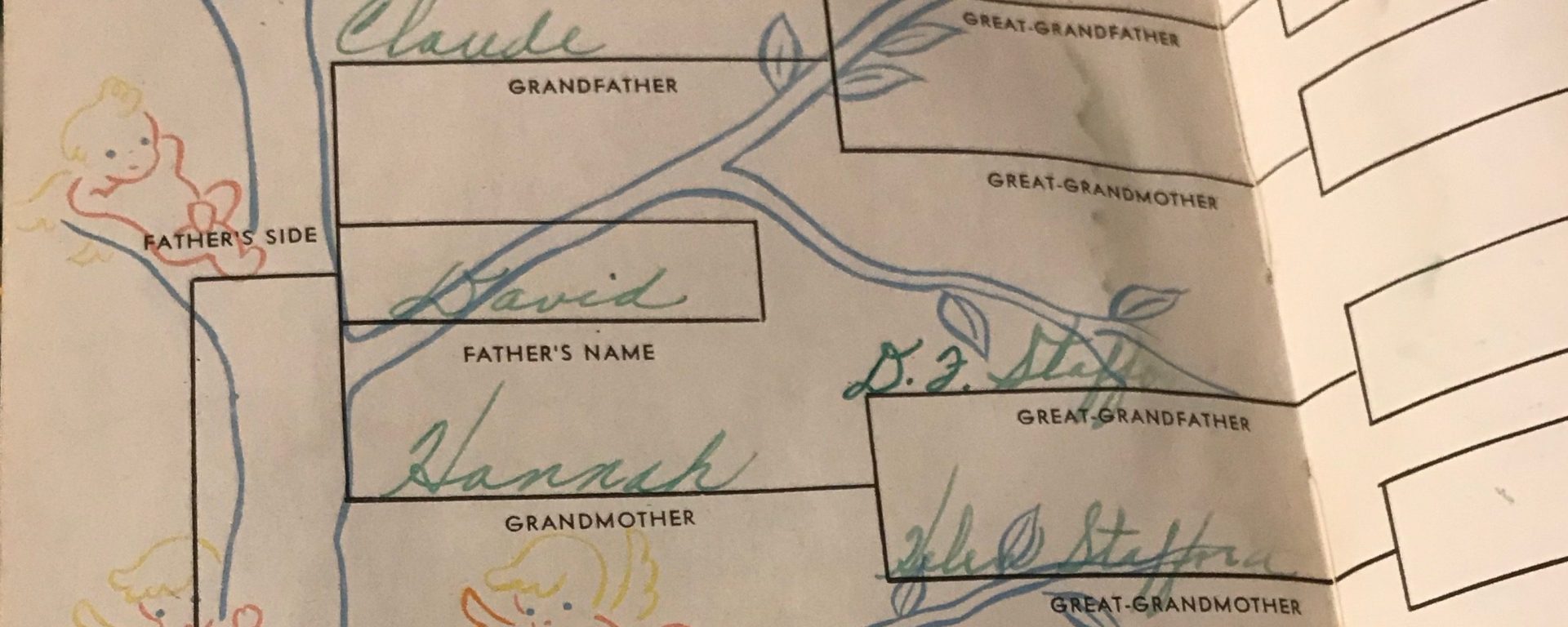
While many individuals posting in closed Not Parent Expected social media spaces reported abandoning their family research on receiving their DNA news, the voices of “screw DNA” responders nudged me onward – granted in a bit of a sidestep. In the Ancestry space where I had originally plotted a tree with data from the old school paper-trail data shared by genealogists in both families, I focused on the Alexanders of my beloved grandfather – Claude, Grumpy as I called him – whose genealogical life story stood started and stopped with his name in my baby book genealogy record. Grumpy’s parents came into our conversations in some memory-sharing conversations that sprang up among out-of-town family visitors stopping by for cakes and coffee; at those moments, Grumpy would allow that he wanted to know “just a bit more” about his people, where they came from before Minnesota, and more elementally, to know his birthplace more precisely than somewhere in Minnesota or Illinois. When I enrolled in a World War I college history class, Grumpy mention his father claimed to be French Canadian, perhaps a 1910s invention to counter assumption that the surname Alexander linked the family to Germany as their small southwestern Minnesota town mobilised for WWI support, with nearly all young men such as Claude enlisting.
*** *** ***
My growing up grandfather had wanted to know “just a bit more” about his people, where they came from before Minnesota, and more elementally, to know his birthplace more precisely than somewhere in Minnesota or Illinois. While I was enrolled in a World War I college history class, Grumpy talked with me about being French Canadian – Gram wondering if this was a 1910s invention made by his father to counter assumption that the surname Alexander linked the family to Germany, a fabrication that would also keep people coming to his thankfully thriving creamery business as their small southwestern Minnesota town mobilised for WWI support, with young men such as Claude enlisting.
Talking during that long Labor Day weekend in 1976, I learned Grumpy had survived military battles in France and Germany unwounded and without shell shock, had withstood trench battles involving mustard gas, and became mildly sick with the 1918 influenza. With patience I gained stories during our last long weekend together about his mother Eliza dying of diabetes complications before his enlistment, of his (favourite) sister Mae dying of the influenza during his enlistment, and his father Frank being newly married and desperate to keep the local creamery open in a post-WWI recession.
Working my way through digital records 42 years later with Claude as a “not biological” grandfather, I drew on patience again to find records of Grumpy being born in Peoria, Illinois, then evidence of Alexanders in three New England states spanning pre- and post-revolutionary decades. Further mapping landed these Alexanders in Stirling, Scotland, which helped to answer the “Where did they come from?” query about the redheadedness of Gram and Grumpy’s two oldest sons.
Doing the more arduous work of finding records for family members who came before Grumpy’s mother Eliza, I found myself taking first steps to reckon with, at least genealogically and in a separate Ancestry space, identifying the person whose DNA had a role in incubating my life, and tracing from that to figure out whether someone in that lineage might well have add some Welshness back into my own set of life facts.
In returning to my genealogical trees, I worked at my dining room table facing the sideboard with family photos and artefacts. Two items there served as my “Huh, I need to think now” focal points: The photo with Gram posed just behind her irises, a small part of her sprawling flowering gardens took up as much room between two houses as did the vegetable garden behind the photographer. A small vase with dried longish twigs, some still holding leaves, that I twisted from plum, elm, maple, and crab apple trees on Labor Day 2005. That day I walked from the local history museum to the home backyard to check one last time on the state of the abandoned house, and to bask in sensory memories of the extended family gathering for a cakes and coffee lunch as part of the town’s annual Box Car Days carnival and parade marking the end of summer.
*** *** ***
Ancestry offers two ways of viewing a tree, both starting from the person who’s situated as the tree’s “home” person. The default view places that home person at the bottom of a screen as the root-trunk of the tree, with ancestors branching up and away. The optional view, my view, is a horizontal one with a home person at the left, the multiple lines of ancestors moving right across the screen. In this view, all my relations flow beyond the screen, others just a node or two on that first screen.
I am at ease in the horizontal view with mapping kinship node by node along multiple pathways so characteristic of rhizomatic plants. The vertical tree view – with that single starter seed becoming a solid trunk needing further branches to produce the fruit of a genealogical search – leaves me feeling isolated on the ground, trapped in the shade of others trying to see where I “fit.” In the horizontal view I feel invited to travel along and with the other running lines, each collection of nodes moving toward people and places as part of discovery and understanding.
I’m not surprised by this preference given homeplace garden was where I found reading spaces – and more importantly safety and attunement – as a child and again as a graduate student who was moving from the history and fiction collections inside the house to the postmodern French theorists I was working my way through on phd-school breaks from classes and teaching.
Deleuze and Guittari, in one strand of that French postmodern theory reading, contrast rhizomes to trees as a means of reorienting – and reinvigorating – ways of thinking about a world that has outgrown the quest for objectivity informing a western scientific method that characterise the construction of knowledge as a linear, testable, and replicable pathway moving towards a “truth.” Ways of knowing and knowledge, in this metaphor begins, like trees, with a single “seed” that can be expected, because the context is controlled for variables, to become a specific type of stem that grows into a solid trunk bearing further branches that produce expected “fruits.” Deleuze and Guittari offer arborescence to refer to the ways that the shape and structure of a tree informs western philosophic and scientific paradigms.
They offer rhizomatic as a contrasting metaphor to make way for showing, as Dave Cormier notes, ways that seemingly unconnected complex aspects of knowing and life can actually form meaningful connections for us. With rhizomatic plants, such as the irises Gram tended and the potato hills Grumpy seeded, the plant’s fibrous nodes sit partly in and partly above the soil, send roots to retrieve water and nutrients that are stored as proteins and starches in each node, which will in turn push up and sustain shoots to become leaves, plant buds, and flowers. The multiple rhizomatic nodes form an organism with interconnections rather than a central seed origin or predetermined end point. Instead, nodes move as water might on a smooth surface to turn with the landscape, or they might be divided to remove withered nodes with the pieces remaining transplanted to map make their own new routes. Sitting as they do partly atop and within the soil, the nodes become weathered across decades of growth, pruning, and transplantation, taking on textures that combine smooth and bumpy.
This is my kind of genealogical gardening, practising what I learned in tending, diving, transplanting in the gardens between the little 113 Morgan Street house my grandfather built for raising four boys, and the larger 131 Morgan Street homeplace that had been home to four generations of the Alexander-Evans-Stafford-Svelstad family. Drawing on the rhizomatic metaphor makes room for me to address genealogical wicked problems – those social, cultural, individual and collective issues that are more complex, interconnected, or difficult, even impossible, to pursue within a single tree, however robustly branched.
Within Ancestry, I began to map with rhizomes in mind: the Stafford-Evans-DeWinter families that formed the heart and head, soul and spirit, if not entirely the bones of me are the iris genealogies. The Alexander genealogy mixes small and big finds, a potato hill that reminds me to dig that “a little bit more” to honor Grumpy’s family story request and appreciate his vegetable gardening tutelage. For a biodude map that seeks to find its Welsh rootings, it’s lily of the valley as a rhizomatic icon that lets me transplant that family into my Ancestry gardening space. To be honest, the lily of the valley choice is a dark choice: that rhizome variety is highly poisonous if consumed by living beings, reflecting how I feel about having this person’s DNA in my body. And, the small bell-shaped flowers, which are partial to shade, were the foundation plant along the shady side of the Mankato house for the 50 years my parents and I called it home.
 The Truth of Things