
On Storytelling
Storytelling is the essential human activity. The harder the situation, the more essential it is.
~ Tim O’Brien
Sometimes writing in private isn’t enough.
Writing in private definitely isn’t enough in trying to tell oscillating stories – stories that see, capture, hold for a minute, invent while thinking – that capture life in the middest of learning something. Nor is it enough for a writer who’s trying to imagine an audience for ideas taking shape. The ideas taking shape in this place will often focus on sorting through thinking that happens in learning that the paternity I carry in my heart and head, soul and history does not match the paternity I have learned that I carry genetically. There’s Pops. There is a bio dude. There are impacts everywhere on learning this new life detail, and understanding of impacts across years before learning that new detail. My first writing about this was a Facebook post to let family and friends in on the secret, and the deeper love of my parents that its discovery evoked.
In stitching together these various stories, words aren’t enough, either. Songs needs to play in between paragraphs, sometimes even need to play to define or context as single word. Images need to show up as part of description, as springboard for description – or to set a tone, to bring a particular hue to a story’s register, to stand in for nascent notions.
Words in other public spaces aren’t enough. Most public spaces are actually secret spaces where people addressing DNA surprises can honestly interact as part of “dealing with” new – always complex, sometimes disheartening, always provocative – information and understandings. Yet those spaces often set limitations on discussion topics, moving any working out of ideas linked to queerness, feminisms, race/ethnicity, politics, and sociopolitical constructs to other forums. They aren’t enough for people sorting and reflecting, reading and responding to complex situations – to situations that fit what writer Tim O’Brien calls hard situations.
As someone who both writes and teaches – as well as teaches writing and teaching – I know that shaping ideas for an audience, for interactions, requires time working through shitty first drafts*, as Anne Lamott rightly calls this process, for storytelling to take shape. The posts here, then, are first attempts to externalise ideas, to perchance connect with other thinkers/readers, and to see about writing my way into something next, something more complex and clear, and to risk sharing bits of the oscillating storytelling on the way.
(*If you get a “Unsupported redirect on a tablet or phone, click the hyperlinked word Back, and you’ll be directed to the resource.)
- A post about the shitty first draft concept.
- A pdf version of Lamott’s Shitty First Drafts essay.
- See also a second Lamott essay, Radio Station KFKD.
On Naming this Blog
It’s not the truth or a truth that I seek to understand in writing the essays for this site, especially in writing about what and who makes a family, about how and where a family takes shape, or about why and when people(s) reject others frameworks meant to limit secular or civil definitions of family, or to malign social organisation of family outside norms established by heteropartriarchal capitalist evangelical religious authoritarians.
The truth of things that I wish to speak about here are the ones that I recognise as co-created across my life. Speaking truth – whether in addressing power, in expressing a personal understandings of events, or in building a reflection on home and broader cultural lives – is done with others. Sometimes those others are present in a writer’s life as living persons, and sometimes as historical – especially genealogical – beings who’ve left imprints on a life through (in)visible actions, interfamily autobiographical stories, and random big and small bits of ephemera passed from one hand to another.
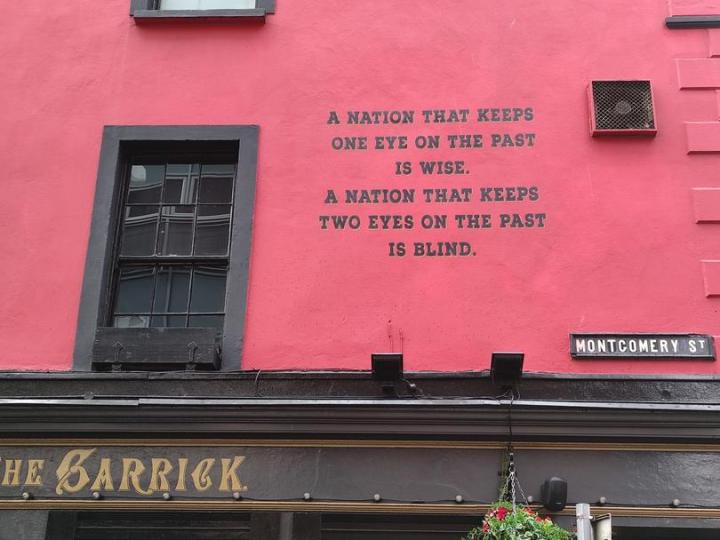
There is no speaking to “my truth” here, no backward glances at what might have been. As a woman raised in a line of Welsh girls and women, I understand hiraeth not as a reflective nostalgia casting a look backward that produces a state of yearning into what was or might have been; rather, I’ve learned to view hiraeth as a form of reflective nostalgia that engages people in movement forward across a long field we journey with others while always engaged looking both back to where we – plural and big, individual and complex – have been been as we navigate moving around a bend that calls us to have an eye on where (all) we might (next) be.
For this work, I need the two-eyed approach put into practice by Myles Horton and Septima Clark, and the double consciousness that W.E.B. Du Bois first articulated as the way of knowing necessary for African-Americans navigating white supremacists worlds set out in Reconstruction, Post-Reconstruction, and Jim Crow eras.
I started this blog as my “digital fieldwork” work/make space while participating in the Teaching Complexity Online Seminar (overview of sessions) curated by Bonnie Stewart (then a Visiting Fellow, University of Arts, London) and David White (Head of Digital Learning, UAL), with #teachcomUAL reflecting the interactions before, during, after, because of seminar sessions.
 The Truth of Things