[O]ne thing we all have in common as humans is the need to connect with others and in my case, this need was to unite with my unknown biological family, my kin, my tribe, even if the discovery only led to being able to look into eyes that looked like mine for a minute. I felt this need to connect on a cellular level and the reason was indefinable to me.
Annette L. Becklund, Ancestry Discoveries (2022)
Somewhere in Kentucky on a 1967 summer trip, I asked if the two horses nearest the roadside fence were mating. Despite being a Minnesota kid raised around farming uncles, the actual mating that produced foals, piglets, calves, chicks, and kittens wasn’t something I’d witnessed. This was a perfect time to ask – bound for Washington, DC, it seemed good to add conversation to the AM radio and library books as my travel companions.
“Yes,” Mom assured me in a direct, “I’m really not going to describe it for you” response. Pops wound down the dashboard’s radio volume, launching a conversation by noting that this was his second trip into the South, and set out a story that I hadn’t expected to hear as part of his life.
“We,” he and his cousin Dale, “were on leave from the Navy, back in the US after several months in Korea, and decided to go to Alabama – it was certainly warmer that winter than Minnesota, and we could bunk at Dale’s in-laws” at their Leeds, Alabama, home. On one of those first nights, Pops left his cousin to wife and family reunion, heading to a movie theater for whatever was showing. Pops loved the excitement of seeing a new movie with the sounds of other people’s reactions, and the lobby or on the sidewalk chats before and after the show as people grabbed a smoke and a snack.
That night he experienced a different lead up to the show in being specifically directed to the balcony. Not a very usual thing for someone from a small town with a one-story movie theater that also showcased touring revues and plays, regional performers, and high school concerts.
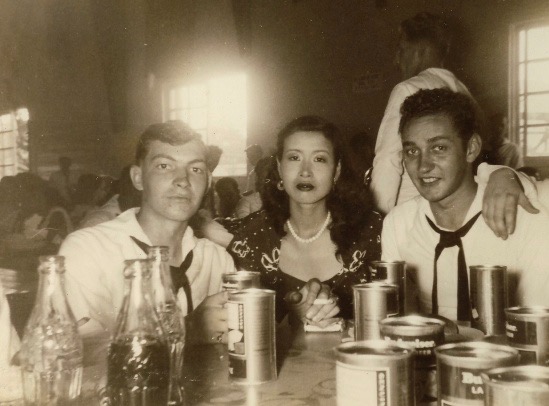
However, the ticket-seller’s words were usual in terms of 1950’s proudly Jim Crow Alabama and the seller’s judgement that Pops was a light skinned black man who would be expected to sit upstairs and join a specific concession link to buy popcorn and a coke. What led to that direction, my dad speculated, was his thick head of black thickly wavy hair and olive complexion that led people in public establishments “to take me to be a light-skinned black man.”
*** *** ***
Our TripTik travel packet mapped out driving routes, separate guides for big city navigation, and listed reserved motels. In all, the TripTik sent us through four southern states – Missouri, Kentucky, West Virginia, and Virginia – to arrive at destinations including Mount Vernon and Arlington Cemetery, and select Washington, DC, monuments, where we would linger longest at the Lincoln Memorial site and grounds.
Fixating on the Eternal Flame as part of President Kennedy’s Arlington gravesite, I allowed myself to gaze on the layout of graves with white stone markers bordering this starker spot. Preparing for the trip, Gram shared stories about her paternal grandparents over photographs. That second great grandfather was a Union soldier from Connecticut whose dual role as musician and medic placed him three times at Arlington during the war. His wife, The Hannah” on our family was a teen on a Minnesota Welsh community working to become a prairie school teacher and recording popular 1860s anti-slavery and romantic poetry that could be used in history lessons she’d teach and oration contests she’d enter. With her, I had learned a pro-Union, abolition, anti-silvery view of the U.S. history, and knew the south to still be a different place.
Once in the District, it was Mom’s stories that shaped my view, whether about Marian Anderson performing on the Lincoln Memorial steps after being banned from singing in the Daughters of the American Revolution’s Constitutional Hall, or reminders about our watching as much of the March on Washington as we could in an era when live television coverage was rare. We’d heard Martin Luther King’s “I Have a Dream” speech, listened to singers including Mahalia Jackson, Joan Baez, and Marian Anderson, and watched the faces of a multiracial crowd gathering at a time when Jim Crow social and political laws could have been enforced with malice. On our day at the Memorial, I held a parent’s hand when one of us wasn’t holding up a camera, especially when we stood together to take in the statue’s face, hands and feet, the words on walls, and the people taking up their own here-for-a-long-minute spaces up, down, and across the steps, each person quieting the closer they came to the statue, whispering at times, especially on looking on a face and hands cast from life masks.
While the visual and felt memories remain strong in me, a segment continues to play frame-by-frame sixty years later: a traffic accident in the District is the focus of a Super 8 movie spooling in my head. The accident featured players include two white police officers who had simply arrived, walking shoulder-to-shoulder toward the minor three-car accident with our car inconveniently wedged between two well-used pickup trucks. A bumper-riding, distracted pickup driver had started this chain reaction by jamming breaks and sliding over the back bumper of our brand new royal blue Dodge Coronet 440, and with a force that pushed the car’s front bumper under the unfinished edge of a wooden box behind a rusted blue pickup cab.
Pops left the car on finding Mom and me uninjured by impacts, thankful at least for that new car with its just federally mandated seat belts. Heading toward the officer making investigation notes, Pops was focused on starting to work with the other drivers to separate the vehicles. Another officer moving along the string of vehicles, looked into our car – Mom telling me to just look ahead and smile a bit. He’d have seen a so very white skinned, softly brunette-haired woman in the front seat and an equally light skinned child with a tangle of fuzzy curls springing from her nearly black hair in the back seat. The officer stepped away to order the black men stepping onto the roadway as helpers to “Move on back.” The three drivers, the white men, carried on with unhooking bumpers, work that would have been speeder with another three or more pairs of hands: “Many hands make light work” is a phrase I link to farm life – threshing, barn raising, food production in slaughtering animals and “putting by” that year’s garden bounty – that should have applied here.
What lingers from this memory film short, however, is the power of a single word’s utterance to change the dynamics among people I saw as ordinary, as just like us. I can’t unhear one officer booming the n-word into his command ordering the black men away, and the other extending that pejorative in referring to my dad when he had spoken about needing help from bystanders. Pops’ earlier words about being “taken for black” were fresh in mind as that same officer scanned the Dodge occupants.
The word sat with me the full span of the vacation days that followed, with stops in New York City for visiting family and the return to Minnesota. I didn’t then – or ever, actually – recount what I’d heard to my parents, and have no recall about whether that silence was linked to some words, some cautions, shared with me. As we returned home, I realize that I had been taken to be the child of a biracial couple, a despised identity in any highly segregated southern city. Only less so despised in my own Mankato hometown.
Then, as the kind of kid who followed the television evening news with my parents and grandparents, I recognized that the Loving vs. Virginia case had been argued before the Supreme Court to determine legality of states barring interracial marriage, and the case was covered in the Life, a photo and narrative rich weekly magazine delivered to my grandparents’ home. The case returned to mind when I was in high school, working from time-to-time at the same factory where Pops was a supervisor, and where he had worked in 1967. Our vacation week was tied to the 4th of July week then, as it always had been because many businesses associated with industrial spray-painting work agreed to shared timing for a summer shut down. The Loving decision was handed down, I had learned in completing 12th grade civics class paper on major Supreme Court cases from 1950-1974, on 12 July 1967, just after the accident that played as a Super 8 movie in my head. The Court’s unanimous decision declared that state miscegenation laws violated the Constitution’s 14th Amendment’s Equal Protection and Due Process clause.
*** *** ***
I did begin letting myself wonder about my face, my hair, my skin tone. About whose characteristics I carried. About how people answered the “Who does Ilene favor?” – the who does a kid look like question of the era. The answer was always Donna, my mom, thanks to my high forehead, negligible nose bridge, overall face shape, straight hair when left unpermed, and that very white skin color. In not hearing With Pops never invoked as being part of my face, I went looking for my own evidence beyond the obvious almost black hair, and wondering why my hair held a perm for months rather than the mere couple of weeks one would hold on for my mom and her sisters. I looked at photos from Pops’ childhood, seeing the dark hair, and the hazel eyes in color photos as sufficient evidences for Pops as part of the “who Ilene favored” equation. Slim evidence, but enough, then.
That search for a somatic facial lineage would recur. In my August 2000 eulogy for Pops, I recalled a moment just after we gathered for his father’s 1976 funeral. Because my first college quarter included a WWI course, I made frequent trips to ask my grandparents questions for the course short paper assignment. During one of those visits, as the eulogy recalls:
My grandmother Hannah caught me in front of the bathroom mirror, glancing from an assortment of photos in my left hand to my reflection in the mirror. I spoke with the urgency of someone caught in the midst of a bad deed: “I need to see you and my dad in my face. When you’re not with me, when you’re both gone, I need to see you in my face.” Gram touched my brow. “Let me have these for a minute,” she said, removing my glasses. “You look just here, just from that short bridge of your nose to the brow. Just there. See the way the bones in your eye sockets make a perfect half circle above the eyelids, the way the corners of your eyes rise to meet your eyebrows in a perfect circle when you smile, the way your slim nose bridge gives way to that wide, flat brow. Those hazel eyes. See that.” And I did. “How can you not see that you are your father’s daughter and my granddaughter when you look yourself in the eyes? Don’t think Alexander, look for my grandma’s family, look for Evans’ eyes.”
I’d benefited from how those eyes looked on the world, so being told I had those eyes for looking on the world mattered to me. I was contented by Gram’s response, which let me feel – cognitively, somatically, curiously, and soulfully – connected to Pops and to the ancestors looking on us across generations.
*** *** ***
With DNA tests becoming available with over-the-counter ease in 2000, a cousin and I decided to do tube spitting in hopes of finding other Welsh and Irish folks connected to the ancestors Gram invoked. Hence, that the DNA discovery of a biodude, which relaunched me into investigating a story for my face, since the parts not clearly linked to Mom were not a match with any maternal relatives I knew in real life or in photographs. This time, I wasn’t aiming to be “on the nose” with a facial match, but to link this new genetic information at human-scale to people who had contributed to my DNA. It would be a bonus to link new data to still-living people who might help me understand Mom’s decision to let this part of my biological story go missing. The data I gathered would become part of a story to help me understand, but significantly not part of a reunion narrative.
To gather evidence linking biodude’s life and family to mom, I studied yearbooks and other 1947 to 1951 high school ephemera in the Wells, Minnesota, history museum, the place where I would find yearbooks for hometown he’d shared with mom. That biodude had just one sibling, and Mom’s 13 older siblings were married and living away from Wells, narrowed the search for a timeline and maybe interests connection. Finding Jeannine, biodude’s sister, required only paging through the Wells Wildcat yearbook, starting with the seniors section of the 1947 edition, where Jeannine is noted as the yearbook editor in an activities listing beside her portrait.
There it was, my own familiar nose – and lips, along with eye and cheek creases. I had the start of a story involving a young woman looking back at me. My quiet “Yahoo, a discovery!” was loud enough that the archivist said “Tell me more” rather than “Shush!” As a contemporary of my mom, the archivist pointed to the listing beside mom’s 1951 senior photograph to note that the two young women shared similar interests, studied my face for a bit, and offered, “You do favor both.”
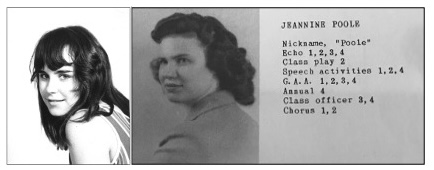
That’s her high school photo age 17 on the right, and the 17-year-old me, on the left side in a self-portrait made for a summer-school-only photography class. Odd, that experience of seeing another person reflecting back parts of my face that had previously appeared only in a mirror. And in the moment, my inclination was to laugh at thinking about my parents playing the “I’ve got your nose” game with me, the one with an adult putting the first fingers of a hand beside the child’s nose, running the pair down to the tip while saying “I’m gonna get your nose,” and displaying the nub of a thumb tucked between those two fingers to depict the nose plucked from a child’s face.
Meant to produce giggles and smiles for adults as well as the bewildered infant or toddler, the thumb between fingers is considered an obscene gesture in cultures where it’s flashed as equivalent to a US middle finger gesture. That hand shape, known as “the fig sign” in the Roman age that extended to Southern and Celtic Europe, as a gesture invoking the scared fig tree was flashed to ward off the evil eye, the evil spirits of dead ancestors.
A nose just is a nose, right? Or maybe it’s also a link to a connection someone wants to ward off, like my mom filling that nose data gap with “You just have your own unique nose” whenever I observe the lack of a tiny cartilage hook on the ends of noses she and her sisters shared. She also honestly acknowledged that the bigger, broader, flared nostril boats of Pops’ family noses were far from a match to the longer sweep of the nose on my face. As I come to understand the several small actions Mom took to place a boundary around me, to ward off connections to biodude that she saw as dangerous – to her, her daughter, and her family – I understand who she didn’t share as a match when she looked on my face.
While personal histories placed Jeannine as an aunt “gone missing” from my timeline, I could fill in some pieces with a robust US newspaper database search toward for traces the high school yearbook narrative. In this research, I found a woman who earned a degree at Mayo Hospital’s School of Nursing, which took her to Los Angeles where she met and married a thoracic surgeon, and took on her own philanthropic role by heading University of Southern California Medical School scholarship fundraising committees. These large-scale, 1970s events held at the Wilshire Country Club featured, for example, a first time US viewing of French Impressionist artworks, auctioning needlework created by men, and recognition of USC alumna Pat Nixon, the then First Lady. Jeannine shared my face into her 40-something years according to the photo displays of feature stories focusing on her community work.
I would call the nose I found – along with the first bits of a story about its other “owner” – a figurative hallmark, something that identifies someone who had (or could have had, in my case) an involvement in another’s life or work. A thumbprint, if you will, on the margins of my life and the stories I learn and can tell. Finding Jeannine’s face helped assure me that the archival and anecdotal research I’d conducted to substantiate my biological link to her brother was valid. He was part of making the biological zygote version of me, but not part of the growing of a me who lives a life in reference to how her grandmother’s and ancestors’ eyes looked on the world.
Sometimes the briefest moments capture us, force us to take them in, and demand that we live the rest of our lives in reference to them.
Lucy Grealy, Autobiography of a Face (1994

